Knebworth: History of Britain’s Famous Music Venue
Knebworth is more than a village in Hertfordshire or the setting of a striking Gothic country house. It is a place where rock, pop, jazz and alternative music have repeatedly turned into shared national memory. This guide explores Knebworth’s history, cultural significance, and the iconic concerts and major music events that made it one of Britain’s best-known music venues, from its aristocratic roots to its era-defining outdoor shows.
Why is Knebworth so important to British music?
Knebworth matters because it became the kind of venue where artists did not simply play another date; they made a statement. Knebworth Park has hosted major outdoor concerts since 1974, and Knebworth House describes the park as internationally known as Britain’s largest music venue and the British home of classic rock. Its natural bowl, historic house setting and large single-stage capacity helped it become a destination for ambitious, big-scale performances. (knebworthhouse.com)
That combination is central to Knebworth music venue history. Many venues are famous for a single legendary night; Knebworth is famous for a chain of them. Across decades, it has welcomed Pink Floyd, The Rolling Stones, Led Zeppelin, Queen, Oasis, Robbie Williams, Sonisphere, Liam Gallagher and more, creating a rare continuity between classic rock, Britpop, pop spectacle and heavy music. (knebworthhouse.com)
From country estate to concert landmark
The story begins long before amplification, festival fields and headline slots. Knebworth House traces its roots back to the Lytton family, with Sir Robert Lytton purchasing the Manor of Knebworth in 1490 and beginning a four-sided red-brick courtyard house. Later generations reshaped the estate, including the 19th-century transformation into the Tudor Gothic style associated with the house today. (knebworthhouse.com)
This older layer of Knebworth history gives the venue much of its atmosphere. Concertgoers were not entering a purpose-built arena with anonymous concrete corridors. They were arriving at a historic Hertfordshire estate, with the house and parkland forming part of the experience. That visual contrast, stately home, open field, enormous stage, mass crowd, helped make Knebworth concerts feel ceremonial as well as musical.

Knebworth’s modern public-event identity developed in the later 20th century. The house’s own history notes that records and memorabilia from events held at Knebworth House and Park form part of its archive, especially from its commercial opening in 1971 and the rock concerts that followed. The first rock concert at Knebworth Park came in 1974, beginning a new chapter for a site already rich in local and national heritage. (knebworthhouse.com)
The 1970s established the legend
Knebworth’s reputation did not grow slowly through small steps. It arrived almost immediately with a run of high-profile shows that linked the park to some of the most important names in rock. The official Knebworth timeline lists The Bucolic Frolic on 20 July 1974, followed by Pink Floyd in 1975, The Rolling Stones in 1976, Genesis in 1978 and Led Zeppelin on 4 and 11 August 1979. (knebworthhouse.com)
Those years set the tone: Knebworth would be a place for large-scale moments, not just touring routine. Pink Floyd’s appearance is remembered for its theatrical ambition, while The Rolling Stones’ 1976 show added another huge name to the venue’s fast-growing mythology. By the time Led Zeppelin arrived in 1979, Knebworth had become a stage where British rock history could feel both monumental and uncertain.
Led Zeppelin’s Knebworth shows became especially significant because they were the band’s last UK performances with the original line-up. The official Led Zeppelin archive records Knebworth Festival dates on 4 and 11 August 1979, and Knebworth House highlights them as the group’s last UK shows in that form. In hindsight, that gives the performances a powerful closing-chapter quality. (ledzeppelin.com)
Which Knebworth concerts became cultural landmarks?
Several Knebworth concerts became landmarks because they caught artists at turning points: final appearances, generational peaks or record-breaking mass gatherings. Queen’s 9 August 1986 show is one of the clearest examples, as Queen’s official live archive describes it as the band’s last concert with Freddie Mercury. It was not marketed as a farewell at the time, which makes its later symbolism even stronger. (queenonline.com)
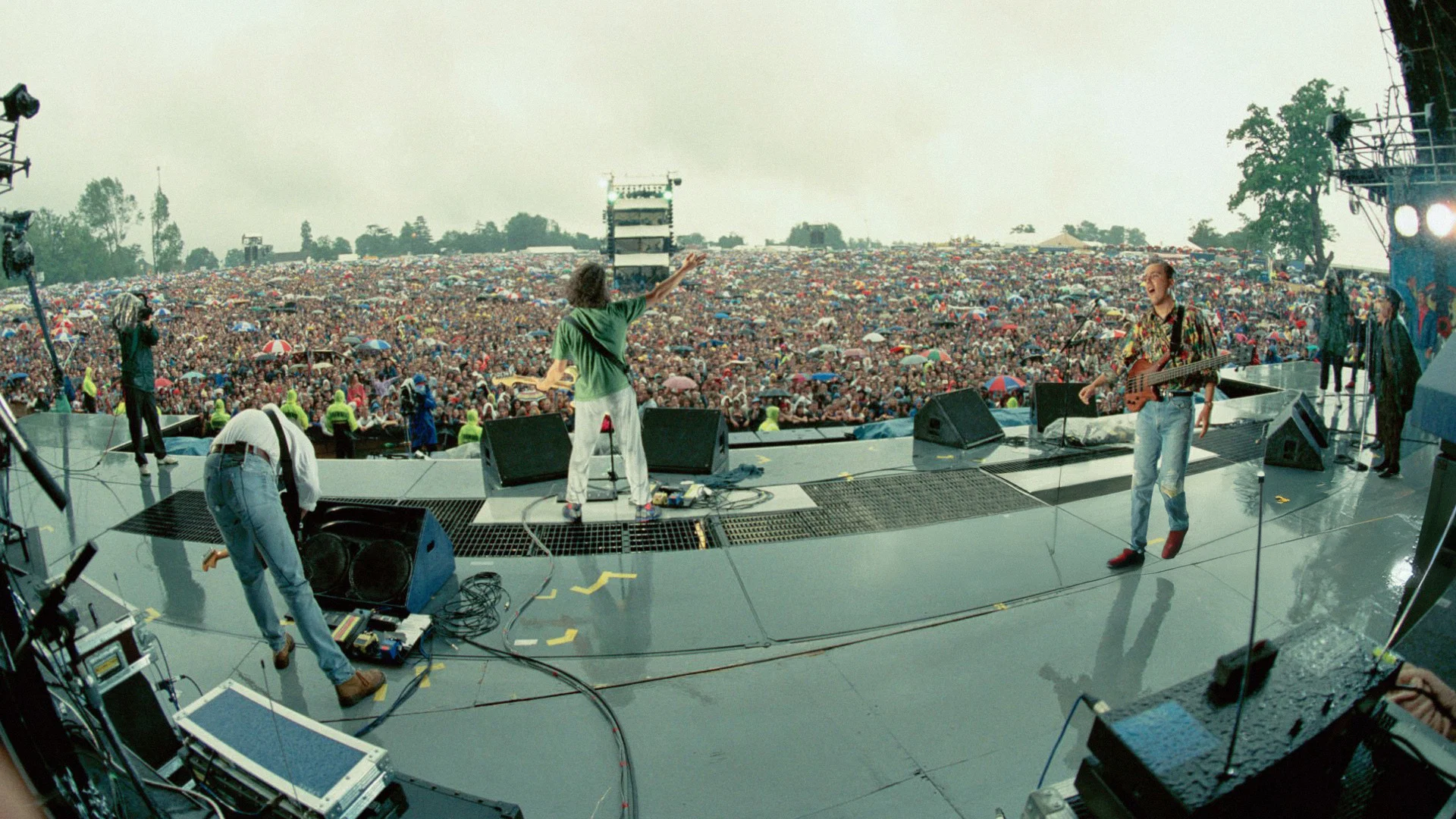
Oasis at Knebworth in 1996 occupies a different place in the imagination. The two shows on 10 and 11 August drew 250,000 fans, and the official film materials describe them as record-breaking, era-defining performances. For many, Oasis at Knebworth became shorthand for Britpop at its absolute peak: confident, communal, loud, imperfect and impossible to separate from the mood of mid-1990s Britain. (sonypictures.com)
Robbie Williams took the site into another kind of pop spectacle in 2003. His official site records three Knebworth shows from 1 to 3 August 2003, drawing 375,000 people across the weekend and setting a new benchmark for UK concert scale at the time. Where Oasis captured a band and a generation, Robbie Williams showed how a solo pop performer could command Knebworth on a vast theatrical level. (robbiewilliams.com)

A quick timeline of defining moments
- 1974: The first rock concert at Knebworth Park began the venue’s modern music story. (knebworthhouse.com)
- 1975: Pink Floyd helped establish Knebworth as a home for ambitious outdoor rock performance. (knebworthhouse.com)
- 1979: Led Zeppelin played their last UK shows with the original line-up. (ledzeppelin.com)
- 1986: Queen played what became Freddie Mercury’s final concert with the band. (queenonline.com)
- 1996: Oasis turned Knebworth into a defining symbol of Britpop. (sonypictures.com)
- 2003: Robbie Williams drew huge crowds across three nights, reinforcing Knebworth’s reputation for scale. (robbiewilliams.com)
- 2009–2014: Sonisphere brought international heavy rock and metal back to the park on festival terms. (knebworthhouse.com)
- 2022: Liam Gallagher’s return connected the modern Knebworth story with the memory of Oasis. (knebworthhouse.com)
Knebworth’s cultural significance goes beyond crowd size
It is tempting to explain Knebworth purely through numbers, because the crowds have often been enormous. Yet the venue’s cultural significance is also emotional. Knebworth has repeatedly been a place where fans could say, with some justification, “I was there,” and mean more than simple attendance.
That matters because live music is not only about sound. It is about timing, identity and shared feeling. A Knebworth show often becomes attached to a wider cultural moment: the endurance of classic rock in the 1970s, the last glow of Queen’s original era in the 1980s, the Britpop surge of the 1990s, the stadium-pop confidence of the early 2000s and the nostalgia-driven returns of later decades.
The setting amplifies this. A festival crowd in front of a historic country house carries a distinctly British mix of grandeur, informality and eccentricity. People remember the journey, the field, the weather, the distance from the stage, the mass singalongs and the sense that the day belonged to everyone present.
Major events kept the venue relevant across generations
Knebworth has avoided becoming a museum piece because new generations have continued to attach their own memories to it. The Sonisphere festivals between 2009 and 2014 brought heavy rock and metal audiences to the park, with Knebworth House highlighting international acts including Metallica and Rammstein among the era’s notable moments. These events gave the site a modern festival identity rather than leaving it fixed in classic-rock nostalgia. (knebworthhouse.com)
The 2020s also revived public interest in Knebworth’s legacy. Knebworth House notes the return of Liam Gallagher in 2022 and the wider impact of the “Oasis Knebworth 1996” documentary. That connection shows how past and present feed each other: archival footage introduces the legend to new viewers, while new shows give long-time fans another chapter to discuss. (knebworthhouse.com)
This is why searches for knebworth concerts still carry weight. People are not only looking for setlists or dates; they are tracing a cultural map of British music. Knebworth has become a reference point, a benchmark for scale and a shorthand for moments when popular music feels larger than entertainment.

What Knebworth teaches us about legendary venues
The best-known venues usually offer more than capacity. They offer mythology. Knebworth’s mythology comes from four things working together:
- A memorable setting: the parkland and house create an atmosphere few outdoor venues can match.
- Historic continuity: the estate’s older story gives modern concerts an unusual sense of place.
- High-stakes bookings: many artists arrived at pivotal points in their careers.
- Audience memory: the fans made the shows culturally durable by retelling them for decades.
That blend explains why Knebworth remains one of Britain’s best-known music venues. Its fame is not based on a single golden period. It has been renewed again and again by artists and audiences who understood that playing Knebworth meant joining a story already larger than the stage.
A lasting place in British music history
Knebworth’s history is the story of a country estate becoming a national music landmark without losing its sense of place. From its Lytton family origins to the first rock concert in 1974, from Led Zeppelin and Queen to Oasis, Robbie Williams, Sonisphere and Liam Gallagher, it has hosted moments that still shape how British live music is remembered.
The reason Knebworth endures is simple: it feels like an event before a note is played. Artists go there to make history, and audiences go there hoping to witness it. More often than not, that is exactly what Knebworth has delivered.