How AI Is Changing Jobs and the Skills Workers Need

AI is changing the workplace, and the skills that will help UK workers stay relevant are not only technical. As automation takes on more routine tasks, people who can use digital tools confidently, think critically, communicate clearly and keep learning will be better placed to adapt. This article looks at practical AI workplace skills in the UK context, with a focus on what workers can develop now rather than distant predictions.

Which skills will help UK workers stay relevant as AI changes jobs?
The most useful skills for AI are those that help people work with technology, not simply compete against it. Digital literacy helps workers understand and use AI-enabled systems; critical thinking helps them check outputs and make sound decisions; communication helps teams turn AI insights into action; and continuous learning helps people keep pace as roles evolve. Together, these abilities make workers more adaptable in a labour market where AI in jobs is becoming more common across offices, shops, factories, public services and professional roles.
This does not mean everyone needs to become a software engineer. For many people, staying relevant will mean learning how AI affects their own role: what it can speed up, what still needs human judgement, and where new risks may appear. The goal is to become more capable, curious and confident in a workplace where human skill and machine support increasingly sit side by side.
Digital literacy makes automation less intimidating
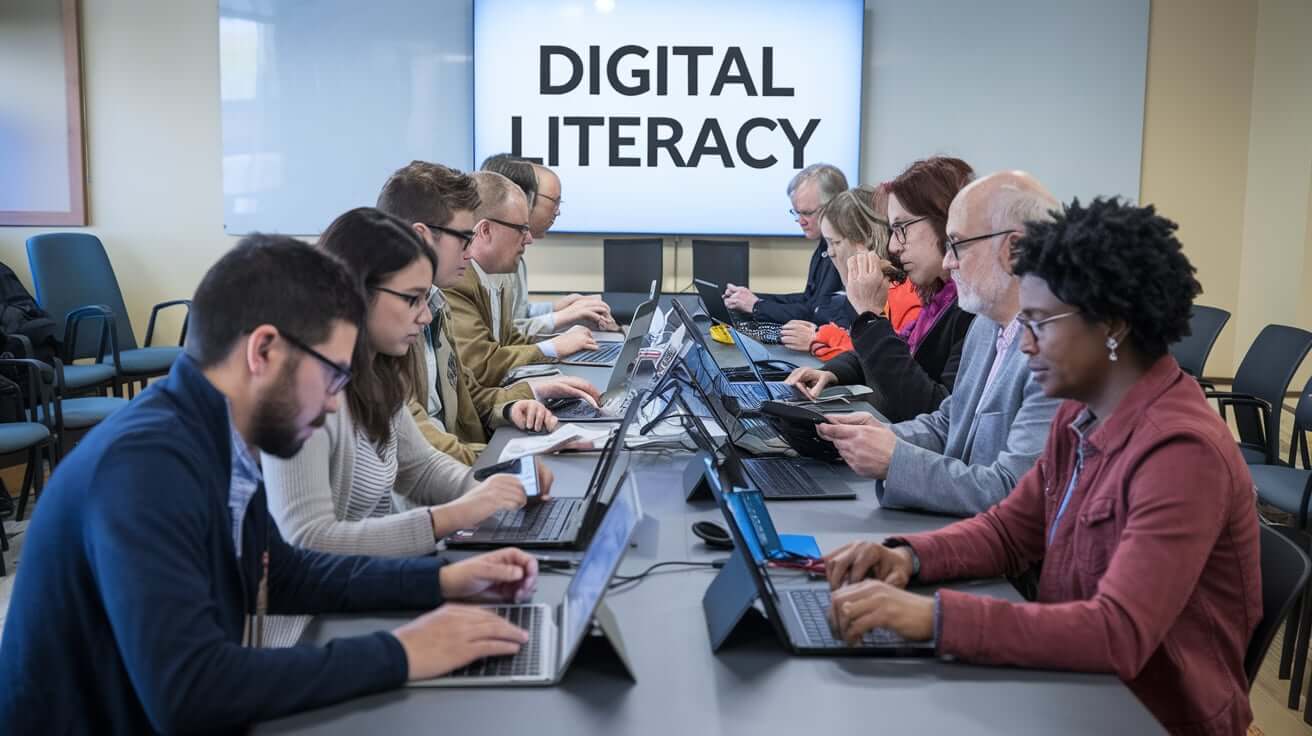
Digital literacy is the foundation for adapting to automation because it gives workers the confidence to use new tools without feeling lost. At its simplest, it means being able to navigate workplace software, handle information securely, understand basic data and recognise what digital systems can and cannot do. In an AI-enabled workplace, it also means knowing how to prompt tools effectively, review automated suggestions and spot when a result needs checking.
For example, an administrator might use AI to draft routine emails, summarise meeting notes or organise documents. A retail worker might use forecasting tools to understand stock patterns. A manager might use dashboards to identify trends in performance or workload. In each case, the technology is only useful if the person using it can interpret the output and apply it sensibly.
Digital literacy also helps reduce fear. When workers understand how a tool fits into a process, automation becomes less mysterious. Instead of seeing AI as a replacement, they can see it as a system that still needs human direction, context and oversight.
Practical ways to build digital literacy include:
- Practising with everyday tools: Learn the features already available in workplace software, such as automation, templates, collaboration spaces and data views.
- Understanding basic data: Know how information is collected, sorted, filtered and presented, so charts and dashboards become easier to question.
- Learning safe habits: Be careful with confidential information, passwords, permissions and the data entered into AI tools.
- Testing outputs: Treat AI-generated text, summaries or recommendations as a draft, not a final answer.
- Asking better questions: Learn how clearer prompts and better context produce more useful results.
Digital literacy is not a one-off qualification. It is a working habit: exploring tools, asking what they are doing, and staying alert to errors or limitations.
Why does critical thinking matter when AI can produce answers so quickly?
Critical thinking matters because AI can produce confident-looking answers that may still be incomplete, biased, outdated or wrong. Workers who can assess evidence, question assumptions and weigh up consequences are essential in any workplace using automation. Speed is useful, but judgement is what protects quality, safety and trust.
As AI becomes more visible in jobs, the temptation is to accept automated outputs because they look polished. A generated report may read well but miss important context. A customer service suggestion may be efficient but unsuitable for a sensitive situation. A scheduling tool may optimise time while overlooking staff wellbeing or practical constraints.
Critical thinking helps workers ask the right follow-up questions. Is the information accurate? Where did it come from? What has the tool not considered? Does this recommendation fit the customer, patient, client or colleague in front of us? These questions are not anti-technology. They make technology more useful by keeping human judgement at the centre.
A simple critical thinking checklist for AI-supported work can help:
- Check the source: Do you know what information the output is based on?
- Look for gaps: What context, nuance or human factor may be missing?
- Test for bias: Could the answer unfairly favour one group, assumption or outcome?
- Compare with experience: Does it match what you know from real situations?
- Decide responsibility: Who owns the final decision, and who will be affected by it?
The workers who stand out will not be those who blindly accept AI outputs, but those who can combine machine speed with human caution, ethics and common sense.
Communication turns AI outputs into useful action
Communication is often overlooked in conversations about automation, yet it becomes more important as technology grows more complex. AI can produce summaries, options and recommendations, but people still need to explain decisions, persuade others, listen to concerns and build shared understanding. A technically correct answer can fail if it is not communicated clearly.
In many workplaces, AI will change how teams collaborate. Some colleagues may embrace new tools quickly, while others may worry about job security, quality or fairness. Good communication helps bridge that gap. It allows teams to discuss what is changing, agree how tools should be used and identify where training or support is needed.
Communication also matters when translating AI outputs for different audiences. A data-heavy insight may need to become a short update for senior leaders, a practical instruction for frontline staff or a reassuring explanation for customers. Workers who can adapt their message to the situation will remain valuable because they help organisations move from information to action.
Useful communication habits include:
- Explaining the “why”: Help others understand the purpose of a new tool, not just the process.
- Using plain language: Avoid unnecessary jargon when discussing AI, data or automation.
- Listening actively: Pay attention to concerns about workload, confidence, ethics or job impact.
- Documenting decisions: Keep clear records of when AI was used and how final decisions were made.
- Giving constructive feedback: Share what works, what fails and what needs refining.
The more automated a workplace becomes, the more valuable human clarity becomes. Communication keeps change manageable, especially when people are learning at different speeds.
Continuous learning keeps careers flexible
Continuous learning is the habit that ties all other skills together. AI tools, workplace systems and employer expectations will keep changing, so workers need to keep refreshing their knowledge. This does not always mean formal study. It can include short courses, peer learning, mentoring, practice projects, professional reading or simply taking time to explore new tools in a structured way.
The most resilient workers are often those who treat learning as part of the job rather than an occasional response to crisis. They notice where their role is changing, identify gaps early and take small steps before change feels overwhelming. A finance assistant might learn more about data visualisation. A teacher might explore AI-supported lesson planning while paying attention to safeguarding and accuracy. A tradesperson might use digital quoting tools, scheduling apps or customer communication platforms to work more efficiently.
Continuous learning also helps workers move between tasks and sectors. As automation reshapes routine work, people who can learn quickly are more able to take on new responsibilities. This flexibility can support career progression, but it can also protect confidence during periods of uncertainty.
A realistic learning plan might look like this:
- Choose one relevant skill: Focus on something connected to your current role, such as using AI for drafting, analysing spreadsheets or improving digital organisation.
- Set a small weekly habit: Spend 20 to 30 minutes practising, watching tutorials or reviewing examples.
- Apply it to real work: Use the skill on a low-risk task before relying on it in more important situations.
- Ask for feedback: Speak to colleagues, managers or mentors about what improved and what still needs work.
- Review every few months: Update your goals as tools, responsibilities and interests change.
The point is not to learn everything at once. It is to build momentum and stay open to change.
Human strengths still matter in an AI-enabled workplace
AI may be able to process information quickly, but workplaces still rely on empathy, creativity, accountability and practical judgement. These human strengths are especially important where decisions affect people’s lives, money, health, opportunities or trust. Automation can support the process, but it should not remove the need for care.
Creativity is one example. AI can generate ideas, but people decide which ideas are appropriate, original, useful and aligned with real needs. Empathy is another. A chatbot may answer a standard query, but a frustrated customer or anxious colleague may need patience, tone and emotional awareness. Accountability matters too, because organisations need people who can take responsibility for decisions rather than hiding behind a system.
For UK workers, the strongest approach is not to frame AI as a contest between humans and machines. It is to ask how human strengths can be amplified by better tools. When workers combine digital confidence with judgement, communication and learning, they become more useful in roles that are changing rather than disappearing overnight.

Practical next steps for workers and employers
Adapting to AI is easier when individuals and organisations share responsibility. Workers can take ownership of their development, but employers also need to create the right conditions: clear guidance, safe experimentation, fair training access and honest communication about how automation will be used.
For workers, the next step is to identify where AI already touches the role. That may be through scheduling, recruitment, customer service, reporting, writing, stock control or performance monitoring. Once those contact points are visible, it becomes easier to decide which skills need attention first.
For employers, the priority is to make change understandable. People are more likely to engage with AI when they know why a tool is being introduced, how it will affect their work and where human oversight remains essential. Training should be practical, role-specific and ongoing, rather than a one-off presentation.
A shared action plan could include:
- Mapping which tasks are routine, judgement-based or relationship-led.
- Creating simple guidance on acceptable AI use.
- Offering training at different levels of confidence.
- Encouraging teams to report errors, risks and useful discoveries.
- Recognising employees who improve processes through responsible AI use.
These steps help turn uncertainty into participation. They also make it more likely that automation improves work rather than simply adding pressure.
The key takeaway
AI is changing work, but relevance will not depend on technical knowledge alone. The most important ai workplace skills UK workers can build are digital literacy, critical thinking, communication and continuous learning, supported by distinctly human strengths such as empathy and accountability.
The future of AI in jobs will vary by sector, role and employer, but the direction is clear: people who can learn, question, explain and adapt will be better prepared. Rather than waiting for change to happen to them, workers can start with small, practical steps now and build confidence over time.